Showing posts with label Travel. Show all posts

Wednesday, September 10, 2025

Port Blair: Where patriotism meets paradise

"From Cellular Jail’s solemn history to coral reefs and tribal heritage, Port Blair blends patriotism, natural beauty, and unforgettable adventures" I write on my experiences on a travel to the Andaman Islands.

Read more at: https://www.deccanherald.com/lifestyle/travel/port-blair-where-patriotism-meets-paradise-3672087


.


Thursday, June 29, 2023

Lisboa-a place you can visit and should revisit


 My Personal Experience and Enjoyment


Thirty-eight years back I went to Lisboa on a scholarship from the Calouste Gulbenkian Foundation for data collection for my Ph. D. in Indo-Portuguese history. Those were the days when we did not have access or affordability to own a mobile to capture fond memories or social media platforms to share fond memories, for that matter even a computer. I only owned a small camera where I could click some photos. In fact, I bought an Antares typewriter to type all my chapters and send it via air mail to my guide who was based in India. I always felt that someday, sometime I will revisit Lisboa and I got the opportunity to do so.

I strongly believe that all good experiences are etched in one’s mind come what may if it has been eons. With this background I decided to travel to Lisboa with my family. The family includes my husband, son and daughter-in-law. We visited them in the UK and then we planned for a week’s trip to Lisboa. Kudos to my son and daughter-in-law for planning the entire trip.


The Journey


We flew from Gatwick Airport (since we were in the UK) and the flight duration was short.

The momnt we landed in Lisboa I had to have my pastel de nata (Portuguese custard tart) at the airport, while the family was retrieving the luggage. Historically, the pastel de nata was made by Catholic monks even before the 18th century.  It is told that egg yolks were used as starch for clothes and the left over yolks were made into custard and tarts, by priests and nuns. However, post the Revolution in 1820 the pasteis da nata was sold by nuns and priests to earn money. But soon a sugar factory bought the recipe and established the Fábrica de Pastéis de Belém in 1983. 


We reached the hotel and took some rest. The next morning, we went walking on the Avenidade de


Liberdidade, the avenue was built between 1879 and 1886 and is modeled after the 
boulevards in Paris. It became the address for people from upper class and the creation was a landmark in the Northwards expansion of the city. During our walk and we saw that the roads are dotted with several statues. The pavements known in Portuguese as calçada portuguesa or calçada (tiny square stones) and is made of limestone. They are hand laid and represent black and white waves ad include symbols and images of animals.


On the way we had sweet pineapple juice at Praca dp comercio-, the uniqueness is the way the pineapple is carved out and the juice extracted is served in the hollow part of the pineapple and the sliced pineapple pieces are placed on the rim of the fruit. In fact, this was available at the touristic spot.


We then went and had lunch at Timeout market which is the is the first market in the world where the food has been chosen, tested and tasted by food critics and journalists. It sprawls over 32,000 sq. ft. with 900 seats and has 26 restaurants & 6 kiosks. Being a vegetarian fortunately we could get food.


The next day we went to Sintra by train which was one the hot destination for the royal family. It was called glorious Eden by Lord Byron it has gardens, castles colourful villas and is surrounded by lush forest. When one walks through the forest you are taken back to fairy tales-Alice in Wonderland, Hansel and Gretel to name a few. In Sintra the mode of transport is bus or one can drive. But we chose to walk to enjoy the environment.


The next day we visited The Belém Tower (Torre de Belém). It was built between 1514 and 1520 by Francisco de Arruda, a Portuguese architect and sculptor in the Manuelino style. It was classified as a World Heritage Site in 1983 by UNESCO. The Belém Tower is built on the northern bank of the Tagus river today it serves as a light house and customs house.


Constructed on the northern bank of the Tagus River, this tower was used to defend the city. Years later, it was transformed into a lighthouse and customs house. It's located right by the Jerónimos Monastery, so we recommend visiting them on the same day. The towers include five floors and all the storeys are connected by a narrow and spiral staircase. Each floor had a designated usage – the King’s room, the chapel, family room, audience room and a roof terrace.

The Jerónimos Monastery is a beautiful structure which includes the Manueline, or Portuguese style of Late Gothic architecture. It has vaulted ceilings and sophisticated decorative elements, and the site reflects the clerical ecclesiastical and royal commissions that characterized the era in which it was built.


What I enjoyed the most was the huge monument - Padrão dos Descobrimentos situated on the banks of the Tagus river estuary, in Belém. It commemorates the departure of Vasco da Gama to India and the Orient in the 15th and 16 centuries, celebrating the Age of Discoveries


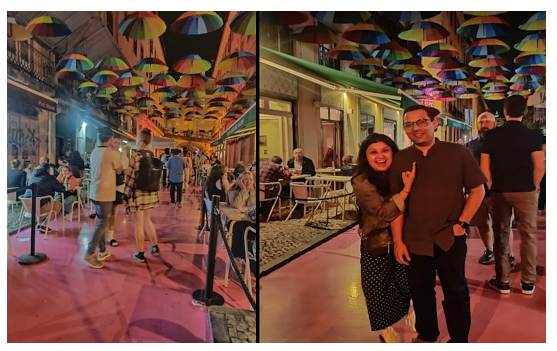
In the evening we went to the Pink street, which is known as the red light area. It used to be home for brothels and it is now dotted with bars, fenced cafes and gambling houses. The reflection of the lights actually gives a pink colour on the street.


The next day we drove to Lagos a town in Southern Portugal's Algarve region. It is an old town which has walls surrounding to include cliffs and the Atlantic Ocean. It is dotted with wooden steps which leads to the cove of Praia do Camilio. The scenario extends to a lighthouse, a castle, cliffs of Piedade and a church (from the 18th century) the Igreja de Santo António.


The next day we went to the Benagil cave, which is also known as Algar de Benagil. It is not only famous but has beautiful caves. History says that the natural caves are more than 20 million years old. Due to erosion the caves have developed cavities in limestone. The boat ride was for around two hours and the natural formation of the caves, mountain ridges was fascinating. We were unlucky to not encounter any dolphins. Our boat “captain” wisely said we do not bait the dolphins by throwing food into the ocean and I thought that was a good approach.


Our last leg was Sagres is located in the extreme southwest of continental Europe. (estimated straight-line path over land-11,241 km, ending near Jinjiang in the People's Republic of China.
We visited the Fortress of Sagres – Fortaleza de Sagres. It is a 15th century fort which has strong walls which tower over the cliffs and served as a stronghold from enemies and invaders. Sagres appears to be a small town with a laid back attitude, there is no chaos or hustle-bustle, despite attracting tourists. The São Vicente – Farol de São Vicente, lighthouse was initially   occupied by the Franciscan monks and hence the name.


We went to a restaurant and had lunch and drove to the airport at Lisbon


We spent most of the day in seeing some sights, since we had to drive back to Lisboa to catch our return flight to the UK. 


Friday, April 10, 2020

Swiss Tales-a Road Trip


I consider myself lucky. I had the opportunity to attend a conference e in Geneva in the first week of February. The first few thought that came to mind was WOW, this is the first time I will be visiting Switzerland, it will be snowing, should I stay back for a couple of days, post the conference, to travel and see some places. The answer to my last question was YES. So I spoke to my son and daughter-in-law who are based in London, to check out if they are available for a road trip in Switzerland, they were game for it! So the planning started and both of them ably charted a road trip and the journey began from Geneva.


We hired a car, from Europcar, and drove through Lausanne, to a tiny but picturesque village – Miège - where we had booked accommodation in an Air BnB. A comfortable 2 bedroom, one bathroom, flat equipped with a kitchen, living area and a small sit out. Basic utensils were provided. What stood out was clear instructions were provided to the guests on how to enter the house by punching in numbers in a secure door lock, and what to do and what not to do. Instructions and contact details to supermarkets, restaurants, takeaways were provided. We reached our accommodation late in the evening and on our way had picked up some grocery and food. Me being a vegetarian, I had to carefully pick up food that I could eat and it was pretty easy. I believe that with most of the world understating vegetarianism and vegans, grocery shops also stock food to cater to people like me. It took us around 4 hours to reach Miège from Geneva as we stopped a few times. The drive was lovely, all you could see was the contours of the Alps, different shapes and sizes. Some were capped with snow, some were bare and some were dotted with pine trees. Miège is a municipality in the district of Sierre and boasts of a unique mixture of history, culture, marketplace and restaurant. It is also a place to taste one of the finest vines. Like, in India we have coffee and tea estates attached to residences, vine yards were spotted outside people’s home.

Miege, Switzerland-Notre Dame replica- Miège is first mentioned in 1226 as Mieio. The municipality was formerly known by its German name Miesen, however, that name is no longer used. Miege houses a replica of the famous Notre Dame cathedral. After traveling around the quaint little town we returned to our house at Miege-the ski village.


The next day we woke up to a barrage of snow. Our car, the lawn, roads the mountains were all carpeted with thick snow. Surely we were disappointed, assuming that we had to be caged in the house. But when we saw the neighbours shoveling their drive way, the city civic authorities sending vehicles (that looked like tractors) clearing the road of snow. This gave us an impetus to get ready, armed with layers of warm clothes and some snacks and water, we drove out of Lausanne. Our first stop was Lake Blausse.  

Blausee is a small lake in the Kander valley above Kandergrund at 887 metres, administratively, it belongs to the Bernese Oberland. The small lake, which is really more a pond, is in the middle of a beautiful 22-acre nature park. According to a legend it is said that a maid lived close by and fell in love with a shepherd. Every day they would row on the lake and spend some romantic moments in the moonlit nights. Unfortunately, one day the shepherd fell off the cliff and died. The maid, would row everyday to mourn for the loss of the shepherd but drowned to death. Legend says that the lake turned to an intense blue colour which matched the maids eye colour.

Factually the lake was created by a landslide over 15,000 years ago. The water is crystal clear and is at a constant cool temperature.


Our second stop was Zermatt, what comes to one’s mind when you think of Zermatt is the Matterhorn Peak. Zermatt is famous for its Ski resorts and is a transport free village. The only way in and out is a train from the neighbouring village - Täsch . Our adventure started after we took a funicular to Sunnega (this houses people and all the ski equipment) and then walked down the ski slope.  We checked with the Tourist centre, since we wanted to go and have a meal at the famous Chef Vrony at Findeln. What we didn’t realise was that when the officer mentioned it is only 10 minutes walk, it was on the snow  ski slope meant to advanced skiers and not tourists on foot! We saw young, old, children where the mothers were holding a harness and skiing after them. This made one realize that people will do anything for the love of skiing. Holding my daughter-in-law’s hand I managed to walk on snow for 45 minutes. The journey was full of adventure, slipped twice – like a professional ballerina – legs in a shape of a diamond, felt scared a couple of times, but never gave up.
Our journey to eat at the Chef Vrony-Findeln was surely an adventure. It is precariously perched on a peak. Originally it was a Swiss Chalet and is today a Michelin-star restaurant, listed in the Gault Millau guides. It is surrounded by the Alps and overlooks the gorgeous Matterhorn peak – lovingly known as the Toblerone Peak. To our disappointment we could not find a table, since we had not booked in advance. However, we were directed to another restaurant which was equally beautiful. The view from the small plateau where the restaurant was perched, was breathtaking. The hostess was a chirpy lady and tried to keep all the patrons warm and happy. We had a hearty meal and were wondering if we had to trudge all the way up? However, we were informed that there is a Gondola (suspended tram) that will take us back. We bought our tickets and went high up facing bitter cold and returned to the base.
The Matterhorn Peak is on the border of the Swiss and Italian Alps. It represents 4 faces which are steep and these face the compass points. No man has dared to venture this glacier. I was in awe of this huge beauty-clear, pure and mighty.

The Principality of Liechtenstein was the next stop. It is the sixth-smallest country in the world and lies in between Switzerland and Austria in the heart of Alps. History says that the Princes of Liechtenstein originally hailed from Lower Austria. They purchased the County of Vaduz and the Dominion of Schellenberg in 1699 and 1712 and merged the 2 areas via an Imperial Diploma.

Vaduz is the capital and home of the Prince of Liechtenstein. Vaduz has a car-free center and encourages tourists to walk around freely. We had a sumptuous meal at Restaurant Adler. The host was friendly, speaking fluent French and managing English. The only words we could say was merci and smile and appreciate the ambience.

We visited Bern and saw the house where Albert Einstein Lived. Being Sunday,
the house was closed, but we managed to catch a glimpse of the house (from the outside). It is located in the center of the Old City at Kramgasse 49around 200 meters from the Clock Tower (Zytglogge

On our last day, we returned to Geneva and walked towards the UN building and Geneve lake. The UN building looks so grand with all the colourful flags swaying with the wind. The Huge chair with 3 legs and one broken leg, speaks of history and stands in from of the UN building main entrance. It symbolises opposition to land mines and cluster bombs, and acts as a reminder to politicians and others visiting Geneva.
To me the trip was awesome, lots of learning and speaks history from every corner.


Fact Sheet
·         Better to have a car and drive around
·         Air BnBs are good and cost anything from 350 swiss franc to 500 swiss franc for 3 nights and 4 days
·         Take lots of warm clothes (layers, if possible), a good pair of walking shoes and an empty water bottle (water is one of the most expensive drinks in Switzerland!)


Sunday, October 13, 2019

A Day in San Fransisco


As an avid traveler, my job allows me to travel, either to attend a conference, seminar or present papers in these events. I also ensure that I plan trips with my family as often as I can. Recently I had the opportunity to attend a course at Stanford University. Post the course I stayed back a couple of days at San Francisco, to be a tourist. Being a historian primarily, I donned the hat of both a tourist and a historian and visited some places. I booked myself on to one of the Hop-on and Hop-off buses, since I had paucity of time and did not want to spend time identifying tourist spots and other destinations.
In 1.5 days, I was able to see some interesting places.  
Chinatown
It is one of the oldest town (China town) in North America apart from being the largest Chinese commune outside Asia. It was established in 1848. It has become the home for several immigrants who find it as a “home away from home”. It is dotted with all types of shops which sell, Chinese vegetables and groceries, trinkets, souvenirs for tourists like me, hand embroidered silk Chinese coats, skirts, bags of all shapes and sizes to name a few. Historically it draws more visitors annually that the Golden Bridge Gate.

Sausalito
My friend took me on a ferry from the Bay to reach this tiny ship building centre during the World Wat 11 -Sausalito.   It is dotted with charming residential communities and unique shops (especially for tourists) and cafes. I could not visit the Bay Model and Bay Area Discovery Museum due to paucity of time.

Fisherman’s Wharf
The wharf relates the history and provides an understanding of the fishing community.
Historic signs, placed along the water’s edge of Fisherman’s Wharf by the Port of San Francisco, tell the Wharf’s history, give insight into today’s fishing community, and explain the need to protect the bay.
It was once a home to a fleet of more than 400 fishing boats. It is also known for filming the famous James Bond movie-A View to Kill (1985), where James Bond meets CIA Agent Chuck Lee to kill Max Zorin the villain.

The wharf is also dotted with little shops and boutiques. I fascinated to see shops entirely dedicated to socks, magnets, caps and sweets and candies to name a few. This apart I saw hordes of sea lions sunbathing on the wharf. They were all lying, not worried a bit, about the onlookers like me. 


Union Square
The Union Square got its name from the pro-Union rallies which was held on the eve of the Civil War. The monument is a tribute to the sailors of the United States Navy. Today it is an ideal tourist shopping attraction. It houses all the brands and shops where one can spend several hours either window shopping or buying some clothes and other accessories.  Historically the Union Square was a huge sand dune but in 1850 it was made into a public park.

Golden Gate Bridge
The massive and huge Golden Gate Bridge was built to connect San Francisco to its northern neighbours. It stretches to 1.7 miles long and is 90 feet wide. Its 4,200-foot main span between the two towers was the longest for a suspension bridge until 1981, while its 746-foot towers made it the tallest bridge of any type until 1993. It took over 5 years for the construction and was formally opened to the public in 1937. It proudly claims itself as an engineering marvel and is believed to be the most photographed bridge in the world.

Pier 35
It serves as a major cruise ship terminal and is in the Embarcadero area. It is known for the market place during the weekends. I visited the market on a Saturday and was amazed to see the fresh vegetables, fruits, sea food. There is a statue of Mahatma Gandhi which was given to the city in 1988 by the Gandhi Memorial International Foundation.  
One of my favourite sight was a doggy park, where owners walked their dogs, the dogs played and the owners chatted and admired their dogs.


Stanford University
It was founded in 1885 by Senator Leland Stanford and his wife Jane to primarily “promote the public welfare by exercising an influence in behalf of humanity and civilization”. It is nicknamed “The Farm” when horses roamed there. It is also nicknamed as “billionaire factory” it boasts of being home to Google, Hewlett Packard and other large economies. In fact, I was able to see a model of the original Google server model-made of lego. Today the University is proud to the birthplace for 19 Noble laureates and is ranked as the top three universities in the world consistently.


I used to go for long walks and discovered the Cantor Sculptor Center where I managed to see some of the great work/sculptors made by Rodin. I also encountered hares hopping across the roads. Students bicycled and were scattered all around the university. Interestingly Tiger Woods an Alumni used to practice golf in the golf course.


Tuesday, March 6, 2018

Through mesmerising Canada

I had the opportunity of travelling to Canada with my family lasy year. I penned down my experiences and it was published in the Deccan Herald. You can read more about this-http://www.deccanherald.com/content/643230/through-mesmerising-canada.html

Saturday, March 18, 2017

A Tale of Cities

An Article I wrote on my passion for collecting magnets was published in Deccan Herald. Check this link to read the same-http://www.deccanherald.com/content/487615/a-tale-cities.html


Beijing the Beauty


I was surprised and happy that I was invited to Beijing to present a paper at the Tsinghua University. This was my first trip to China. I had several apprehensions-people had warned me that the English language could be a challenge and being a vegetarian I may find it difficult to find “pure vegetarian food”. Of course the only solace is that I eat eggs, but did not want to project this as a preference. I went through all the formalities in office and received all the required documents. While I was planning the professional aspects of the trip, I also started planning the personal itinerary for the trip.

I had decided to stay back 2 days in Beijing post the conference. So I started talking to friends who had visited Beijing earlier. I took a lot of tips from them and planned accordingly. Then I conducted some research on the internet and jotted down things that would be of interest to me.  In all my travels, I am quite clear that there is a 2-pronged aim. One is to visit some of the places of tourist interests or something that was always on my bucket list. The second is to amble on the streets, tiny alleys with no agenda. This is mainly to understand the people, culture, traditions (whatever little I can).

Keeping the above in mind, I planned accordingly. Before I embarked on this sightseeing trip, I had a fantastic time with a journalist friend Feng whom I had established contact with, prior to my visit. She took me out to dinner to a vegetarian restaurant. The ambience was lovely, the menu card (I should rather say book) was even lovelier with graphics and a huge menu. With help from Feng I believed I chose “pure vegetarian” dishes. However, I think I ate fish which was supposed to be rice crispies!!

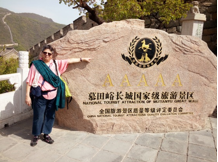
I then launched on to the solo touristic trip. With the help of one of the organisers of the conference, I booked myself on a coach to visit the Great Wall of China. This would be the second wonder of the world I would be visiting (the first being the Taj Mahal). I had to go to a meeting point from my hotel and it was an ordeal asking the receptionist to book a cab for me, due to the lack of English language at the hotel and lack of Chinese language from my side. Of course my experience in playing dumb charades and sketching came into use. I enacted walking up the China wall and drew the same to explain my requirement.


I reached the meeting point and Victor our guide came to pick me up. The journey was for about 1.5 hours.  This is where I met some Indians, Pakistani and tourists from other countries. Victor explained the tour and set the expectations for the trip, for the next few hours. On our way, we stopped at a small village (Huairou County) to pick up snacks, coffee etc. According to Victor, it was inexpensive to buy from the small shop than to buy at the Great Wall of China which would be far more expensive. 


Then we passed a village Mu Tian Yu where the government has encouraged local artisans to set up their wares and artefacts for selling. It is said that it mandatory that all tourists need to walk through the village street and pay a toll, which goes towards the up keeping of these artisans.


We continued our journey to the Great Wall of China. Apparently the wall measures up to 629 kms in Beijing alone and the official length is 21,196.18 km across the whole of China. History claims that small fortifications were built as early as the 7th century. The wall also served as a defensive shield apart from being a corridor to transport goods for trading purposes. The wall is intermittent with openings to act as defensive barricade. Officially it is over 2,300 years old.  Once we arrived we purchased tickets for the cable car and were asked to choose number 14 which takes us right to the top and brings us down. It costed us 100 yuan (to and fro). 

The ride was awesome and it really made me and the other co-passengers admire the skills of the craftsmen who had built it without any modern technology or conveyance to carry the material where they had to walk miles and miles up the hill, and here we were traveling in a cable car to admire the same. I believe the wall has several memories. Along the wall are several arch gates which are built of brick and stone. They are cemented by a mixture made from rice starch which holds it fast.


The wall has several watch towers which served in identifying enemies and also in protecting the city. The steps are narrow and steep in some places. The walk on the wall is quite easy in most places, but it is a very long walk. I could only cover three towers and then returned to wait for Victor - our guide and co-passengers at the base. Talking off Victor, apparently all Chinese people have 2 names-Chinese and English counterparts. So Victor’s name in Chinese is actually Wu  (meaning victory). We then had lunch at Mr. Yang a small restaurant. The vegetarian meal we got consisted of boiled cauliflower with red chillies, tomato with scrambled egg, lettuce salad, aubergine and fish and chicken (which is considered vegetarian and of course I did not eat it).
We returned to the city and I visited the Lama temple with some friends (from India and Pakistan) I had met on the tour.  The temple was beautiful and the building and artwork of the temple is a combination of Han Chinese and Tibetan styles.
We then visited the Silk market where we shopped a bit and went for dinner to Ganges (an Indian restaurant run by a Gujarati-Yogesh Patel from Mumbai).

The next day I decided to take it a bit easy and visited the Tianaman Square. It was initially built in 1417 during the Ming Dynasty (1368 A.D.- 1644 A.D.). History claims that this was the front door of the Forbidden City. It was used for celebrating ceremonial events and was meant for only the royalty. It is a well-guarded place with several security men placed all over the square. The entry to the mail square is free.

Unfortunately I could not enter the Forbidden City (also known as Palace Museum) since it is closed on Tuesday’s. However, whatever exterior I saw, was lovely and huge. It is said that the palace was the home for over 24 Chinese emperors from 1420 to 1911. The Palace is surrounded by a moat which is 3,800 metres long and52 meters wide.
One of the unique things I discovered in Beijing, was the number and different types of electric vehicles. The 2-wheelers would appear silently and if you are not careful bump into you and receive some swear words from the rider!!


Tips to Travellers:
ü  Research well before going to Beijing
ü  Contact people who have visited earlier for some guidelines
ü  Write down names of key destinations (perhaps along with some pictures) in Chinese and English
ü  Wear comfortable shoes since there is a lot to walk
ü  For vegetarians please equip with some pre-prepared food (and MTR ready to eat stuff)